The Break You Get Depends on the Cuff Width
Three chinos compared on leg shape and break — what the cuff width does to the stack of fabric at your shoe, and how to order the right inseam.
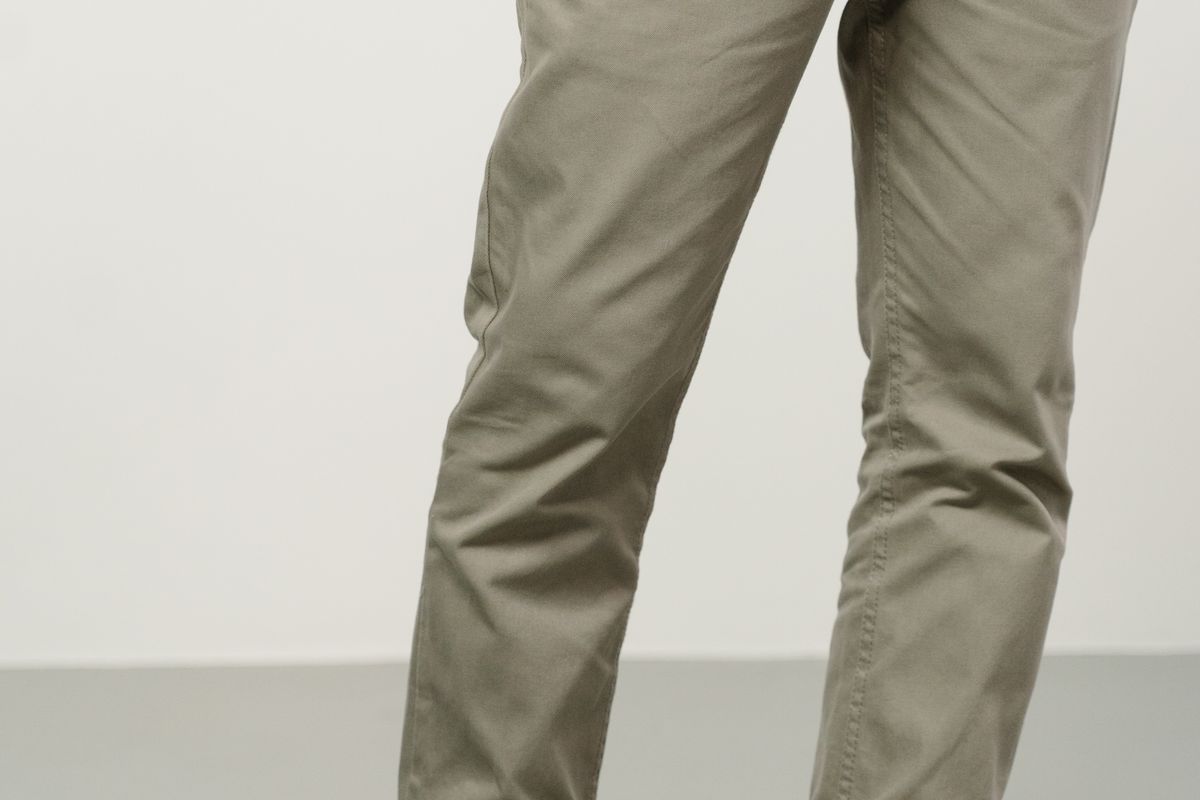
The break is the only part of a trouser most people can actually see, and it is the part almost no product page explains. It is the fold of fabric where the front of the trouser meets your shoe. What controls it is not the waist or the rise — it is the inseam and the cuff width working together.
Break is just fabric length
No break means the hem grazes the laces. A half break leaves roughly half an inch of fabric resting on the shoe. A full break doubles that into a visible stack. None of this is a quality signal; it is a length decision. Order the inseam to the shoe you actually wear, not to a generic size label, and the break follows.
Each setting buys something and gives something up. A no-break hem is the sharpest line, but it is the first to betray a sitting position: the hem climbs the shaft of the shoe and the sock does the talking instead. A half break is the compromise that survives sitting, walking and a shoe with some bulk to it. A full break gives the most fabric to work with at the hem and reads heaviest, which is why it pairs with wider legs and heavier cloth rather than with a slim profile.
Cuff width is the multiplier
Cuff width is the leg opening — the circumference of the hem. A tapered leg has a narrow opening; a straight leg has a wide one. The same inseam stacks a short break on a tapered leg and a long break on a straight leg, because the narrower opening piles the excess fabric higher up the shin. This is why two chinos with identical inseams can look like they break completely differently: the cuff width, not the hem, is doing the work.
The mechanism is overflow. A hem of a given circumference can pass only so much fabric before the surplus has nowhere to go but upward, the way water fills a narrow glass faster than a wide one at the same pour rate. Add half an inch of inseam to a wide straight leg and the extra cloth mostly falls flat against the shoe. Add that same half inch to a narrow tapered opening and it has to fold, because the opening cannot hold it at hem level. The taper turns length into folds.
Fabric weight joins the equation. A heavier twill hangs and folds into a deliberate-looking stack, while a light technical twill tends to collapse into small wrinkles at the same opening. Two legs cut identically in different cloth will not break the same way, which is one more reason the number on the inseam label is a starting point rather than a verdict.
Product photography rarely helps here. Listing shots show the trouser on a body or a mannequin posed to flatter the leg, and the hem is either cropped out of frame or pinned short for the camera. Where a brand does show the hem, the shoe underneath is usually the one the stylist chose, not the one the buyer wears. The photograph is evidence of styling; the leg-opening figure, where published, is evidence about the garment. Only one of the two survives contact with a different shoe.
What the wrong break costs
The hem is the part of the trouser that works hardest against the ground, and the wrong length shows up there first. A hem that reaches past the heel catches on the shoe as it flexes, and that contact grinds one line of fabric against itself until it frays. Mud and rain travel upward along the extra cloth that a full break provides, so the hem darkens before the rest of the leg does.
There is a repair ceiling too. Tailors shorten from the bottom, and they can only shorten by what the original hem allowance offers — usually somewhere between one and two inches on an off-the-rack chino. A trouser bought two inches too long can often be saved; one bought four inches too long usually cannot, because there is not enough fabric in the original hem to rebuild it. Ordering long and planning to fix it later is a wager on an allowance most product pages never state.
Sitting raises a separate failure that the mirror misses. Standing in front of a dressing-room glass tests one posture. Sitting down pulls the hem up the shin by several inches, and a leg cut with no allowance to spare exposes the ankle and sock the moment the wearer takes a chair. This is why a break that looked exact while standing often reads short by afternoon, and why the half inch of reserve that a half break carries is not wasted length but insurance against every seated hour in the trouser’s week.
Three chinos
Uniqlo Stretch Slim Fit Chino is the straight-leg option, 97% cotton with 3% spandex in a slim straight profile from waist to hem, so its opening is moderate and it takes a clean half break without fuss; inseam alteration is available in store.
Everlane The Performance Chino is the tapered option, 94% cotton with 6% elastane in a slim cut with a slightly tapered leg, so its narrower opening wants a shorter break or none at all to avoid a stack; inseams run 28 to 34.
L.L.Bean Wrinkle-Free Double L Chinos are the classic option, 100% cotton in an 8.6 oz midweight with a straight leg, so the wide opening is built for a full break and the no-iron finish means the crease survives the luggage.
How they compare
| Material | Leg shape | Inseam | Weight | Price | |
|---|---|---|---|---|---|
| Uniqlo Stretch Slim | 97% cotton, 3% spandex | Straight slim | Alterable in store | Light stretch twill | Not published (US) |
| Everlane Performance | 94% cotton, 6% elastane | Slightly tapered | 28–34 in | Light technical twill | USD 98 |
| L.L.Bean Double L | 100% cotton, 8.6 oz | Straight classic | 28–34 in | Midweight | USD 69.95 |
The practical read: Uniqlo is the unfussy straight leg for a half break, Everlane is the tapered leg that prefers a short break, and L.L.Bean is the straight classic built for a full break and travel. Order the inseam to the shoe, then let the cuff width decide how much folds.
Reading the leg opening before you order
Most chino product pages state the inseam; fewer state the leg opening, and the leg opening is the number that predicts the stacking. Where a listing does publish it, the figure is usually the circumference at the hem, given in inches or centimetres. Two legs at the same inseam with openings half an inch apart will break differently, so that second number deserves a look whenever it exists.
When it does not exist, a tape measure supplies it. Lay a pair whose break already looks right flat on a table, measure straight across the hem opening, and double the figure. That is the opening that works at the wearer’s current shoe rotation, and it converts any listing’s published leg opening into a direct comparison. The same flat-lay habit is what makes a jeans inseam transferable between brands, since denim sizing drifts for the same reasons — how jeans should fit covers the denim version of the problem.
A second flat measurement sharpens the comparison: the width at the knee, taken the same way, about halfway down the leg. The relationship between knee width and hem width is what the word “taper” actually measures, and two legs that both call themselves tapered can differ by more than an inch at one or the other point. A leg that is generous at the knee and narrow at the hem stacks fabric above the opening; a leg that is nearly straight from knee down stacks far less. With both numbers in hand, a listing stops being a set of adjectives and becomes a set of coordinates.
What a tailor can change, and what they cannot
Shortening is the straightforward operation. The tailor takes the hem apart, trims the excess, and rebuilds it, and the break moves by exactly the amount removed. On a plain hem this is the most predictable alteration in clothing. On a trouser with a finished cuff, the cuff has to be reattached, which costs more and demands more original allowance.
Tapering is a different operation with different limits. Narrowing the leg means opening a seam from the hem upward and resewing it along a new line, which moves the leg opening and the break behaviour at the same time. It is the right fix when the length is correct but the leg pools anyway; it is the wrong fix when the real problem is an inseam bought too long. And once the alteration bill climbs past a fraction of what the trouser cost, the repair stops making sense on anything but a garment worth keeping for years.
Break by shoe type
The shoe under the hem changes what the same inseam does. A dress shoe sits low, so the hem meets it close to the ground and a half break reads clean. A running shoe has a bulky collar and a thicker sole, which pushes the contact point up and effectively shortens the leg; the identical inseam that half-broke on a dress shoe can sit at no-break over a sneaker. A boot goes further, because the shaft itself becomes the surface the hem rests on, and a trouser cut for dress shoes will often hover above it.
This is the argument for ordering the inseam to the shoe actually worn with that trouser most weeks, rather than to an average. The flat top of the foot and the collar height of the shoe are measurements worth knowing on their own — how a shoe should fit sets out which of those numbers matter. A trouser worn with two very different shoe types is the case where a tailor earns the fee, because no single off-the-rack inseam serves both.
The one step: try each chino with the shoes you wear most, and shorten the inseam a half inch at a time until the break sits where you want it — not where the size chart assumes you stand.
The picks
Uniqlo Stretch Slim Fit Chino
Best for a straight, unfussy legA 97% cotton, 3% spandex chino with a slim straight profile from waist to hem, so the leg opening stays moderate and the trouser takes a clean half break without alteration fuss. Inseam shortening is available in store, which is the easy way to set the break. The trade-off is that the fabric is a light stretch twill with no published US price this session.
What works
- — Slim straight profile that breaks cleanly
- — 3% spandex for easy movement
- — Inseam alteration available in store
What doesn't
- — No published US price this session
- — Light twill shows creases
- — Straight leg is not for a tapered look
Everlane The Performance Chino
Best for a tapered, technical leg4.6
A 94% cotton, 6% elastane chino in a slim cut with a slightly tapered leg and regular rise, with 4-way stretch, sweat-wicking and quick-dry claims from the brand. The narrower opening wants a shorter break or none, or it stacks. Inseams run 28 to 34 and the brand notes customers often size up. At USD 98 it is the priciest of the three with a strong published rating.
What works
- — Slightly tapered leg, modern line
- — 4-way stretch with sweat-wicking claim
- — Published rating of 4.6 from 1174 reviews
What doesn't
- — Narrower opening stacks a long break
- — Customers report inconsistent sizing
- — Priciest at USD 98
L.L.Bean Wrinkle-Free Double L Chinos
Best for a straight, no-iron legA 100% cotton, 8.6 oz midweight chino in a classic straight-leg fit that sits at the waist and trims through hip and thigh, built for a full break and travel. The no-iron treatment means the crease survives the luggage, and the fabric is shrink-resistant. The straight opening is wide by modern standards, and the published customer rating on the brand page is lower than the other two here.
What works
- — Straight leg built for a full break
- — No-iron, shrink-resistant 8.6 oz cotton
- — Deep, roomy pockets
What doesn't
- — Wide opening reads old-fashioned to some
- — Mixed published rating on the brand page
- — Midweight, warm for summer
Comparison
| Specification | Uniqlo Stretch Slim Fit Chino | Everlane The Performance Chino | L.L.Bean Wrinkle-Free Double L Chinos |
|---|---|---|---|
| Material | 97% cotton, 3% spandex | 94% cotton, 6% elastane | 100% cotton, 8.6 oz |
| Leg shape | Straight slim, waist to hem | Slim, slightly tapered | Straight classic |
| Inseam | Alterable in store | 28–34 in | 28–34 in |
| Care | Machine wash cold | Machine wash cold, tumble low | Machine wash and dry |
| Price | Not published (US) | USD 98 | USD 69.95 |
FAQ
- What is the break on a pair of trousers?
- The break is the fold of fabric where the trouser front meets the shoe. No break means the hem just touches the laces, a half break leaves roughly half an inch of fabric resting on the shoe, and a full break doubles that into a Visible stack. It is controlled by inseam length, not by the waist size.
- What is cuff width on trousers?
- Cuff width is the leg opening — the circumference of the hem. A tapered leg has a narrow opening, a straight leg a wide one. The same inseam produces a shorter break on a tapered leg and a longer break on a straight leg, because the narrower opening stacks the excess fabric higher.
- Should I order a longer inseam for a tapered chino?
- Usually no. Because a tapered leg already stacks a given inseam higher, ordering extra length quickly turns a clean half break into a sloppy full break. Order the inseam to your shoe with the break you want, then let the leg shape do the rest.
Sources
Written by
Nora Finch
I started Dressing Time after one too many orders that came back in the wrong size. Everything here is built from published specifications, brand measurement charts and what owners actually report.
More in Everyday Wardrobe