Why Clothes Shrink: Three Mechanisms and What Each Fibre Will Do
Cotton, wool and synthetics shrink for three different reasons. How much shrinkage to expect from each fibre, and what to check before the first wash.
The return reason that frustrates me most is “shrunk after one wash, my fault.” It is usually not anyone’s fault. Shrinkage is not one phenomenon but three, the label warns about only one of them loosely, and two of the three are fully predictable from the fibre content alone — five minutes before checkout, before the garment ever touches a washing machine.
Relaxation: the first-wash shrink
Woven and knitted fabric is stretched on machines during finishing, and it holds that tension until the first wash releases it. The cloth relaxes back toward the shape it was woven in. This is the mechanism behind the cotton shirt that fits on day one and feels a half size trimmer after its first trip through the machine.
It happens once, at any water temperature, and it is mostly in length — fabric shrinks more on the grain it was stretched along. Two to three percent is typical for a cotton poplin that has not been pre-shrunk, which on a 32 inch inseam is close to an inch. That is the difference between a full-length trouser and one that suddenly skims the shoe. Reading the care label tells you what the manufacturer tested against; the fibre content tells you what relaxation will do.
Felting: the wool problem
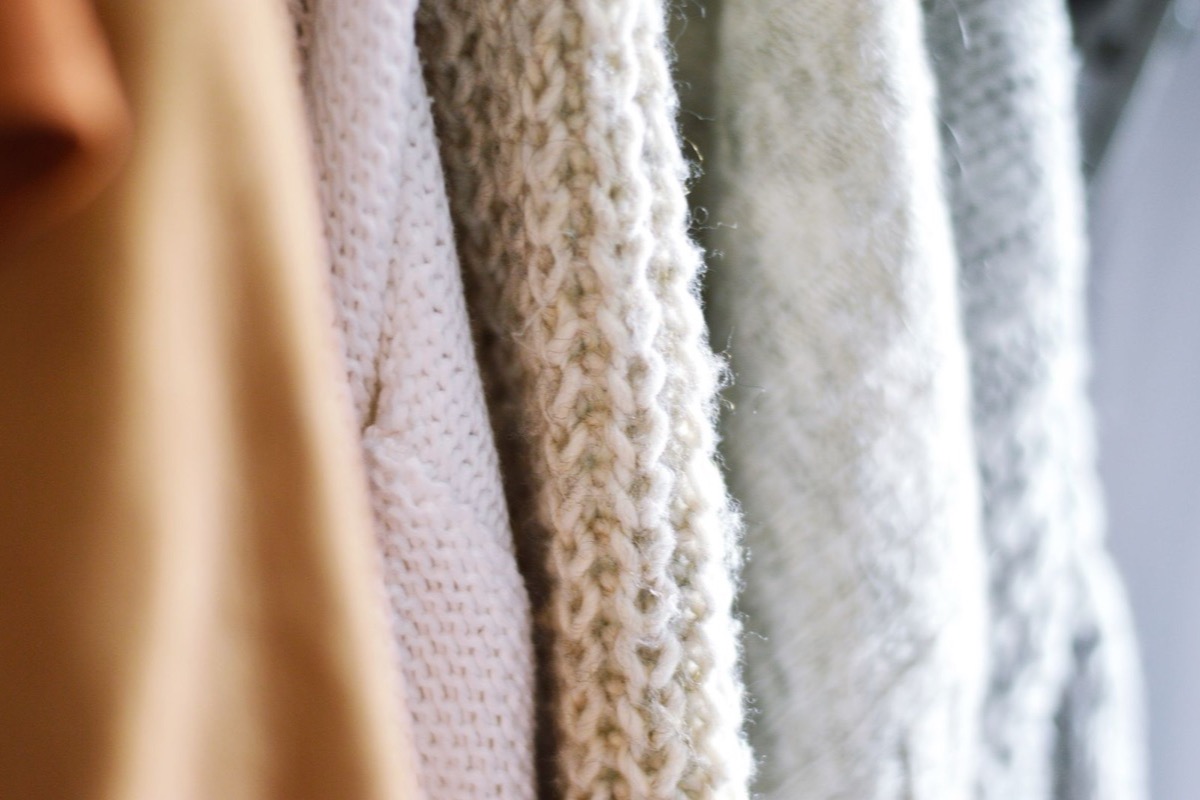
Wool fibre is covered in scales, like shingles. Heat, moisture and agitation make those scales grab the neighbouring fibre and lock — the same principle that turns loose fleece into felt. Each wash that agitates a wet wool garment tightens the structure a little more, and the process cannot be reversed.
This is the only one of the three mechanisms that can take a sweater down a full size or more, and the label’s “hand wash cold” is aimed entirely at it. Hand washing works because you control the agitation, not the temperature alone. A superwash-treated wool has the scales stripped or coated, which is why it survives a machine — the fibre content line will say so.
Thermal: the synthetic surprise
Polyester and nylon shrink the least, but they shrink in one specific way: high heat relaxes the fibre as it was set. A polyester jersey washed hot and tumble dried hot can pull in a couple of percent, permanently. It rarely reaches size-changing territory, which is why synthetics carry the “wash cold” instruction more as a formality than a warning.
What to check before ordering
Fibre content is the whole prediction. Cotton or linen without a pre-shrink claim: expect 2 to 5 percent, mostly in length, on the first wash — if the fit matters, that argues for the longer of two sizes, or for checking which measurements actually predict fit rather than the label size. Wool without superwash: plan the washing routine before the garment arrives, because felting punishes improvisation. Synthetics: negligible, unless you launder hot.
Knits deserve one extra step of caution. A knitted cotton shrinks more than a woven one at the same percentage, because the loop structure has more give to relax into — the same reason knitted fabric pills where a woven would not.
The one step
Before checkout, read the fibre content and ask which of the three mechanisms it is exposed to. If the answer is relaxation and the garment is a trouser or a fitted shirt, size the decision around the first wash — the garment you own after it is the one you actually bought.
FAQ
- Can a shrunken garment be stretched back?
- Partly, and only for one type of shrinkage. Relaxation shrinkage — a cotton shirt gone snug after the first wash — can be eased back by soaking in lukewarm water and reshaping while damp, because the fabric only gave up manufacturing tension. Felting shrinkage in wool is irreversible: the scales have locked together, and no soaking undoes that.
- Does washing in cold water prevent shrinking?
- It prevents less than people expect. Cold water lowers the risk of felting in wool and thermal shrinkage in synthetics, but relaxation shrinkage happens on the first wash at almost any temperature, because it is the release of tension from weaving and finishing, not a heat reaction.
- Do pre-shrunk clothes still shrink?
- A little. Fabric labelled pre-shrunk or sanforized has been compacted in advance, and the standard it is held to leaves a residual shrinkage of about one percent. On a 30 inch shirt body that is under a third of an inch — real, but not a size change.
Written by
Nora Finch
I started Dressing Time after one too many orders that came back in the wrong size. Everything here is built from published specifications, brand measurement charts and what owners actually report.
More in Fit & Buying Guides